 MEWC
 FMWC
 TAC
 EEO

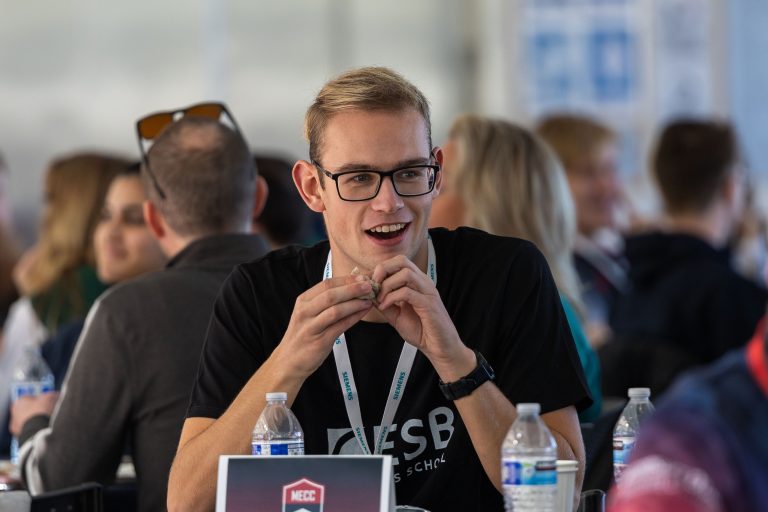
Meet Julian Poeltl, a 23-year-old Excel enthusiast from Germany and accounting student at ESB Business School – Hochschule Reutlingen. His passion for spreadsheets has led him to compete at the Microsoft Excel Collegiate Challenge (MECC) finals, where he embraced new challenges and connected with fellow Excel aficionados from around the world. Join us as Julian shares his insights and experiences in the exciting world of Excel esports.
How did you find out about the Microsoft Excel Collegiate Challenge (MECC) and what made you interested in participating?
I have liked and used Excel for a few years and am a bit of an Excel nerd. After watching an Excel esports video from the FMWC, I went to the FMWC website and found out that there is also a dedicated competition for students, which I signed up for just in time to participate in the qualifying rounds. It was more out of curiosity than a competitive mindset that I signed up for, but after working with Excel esports for about a year, I’m more than glad I stumbled across it.
How did you prepare for the MECC, and what specific skills did you focus on developing?
Well, I didn’t prepare for the qualifying rounds at all – mainly because I signed up so close to the event. After I qualified for the finals, I at least went through all the monthly rounds and the final cases from the previous session. But in hindsight, I don’t think my preparation was sufficient. For example, I went into the final without knowing how to use data tables, so I solved the volleyball case from the 2022 final in my preparation using VBA – very inefficient if you know data tables.
What was the most challenging aspect of your MECC experience last year?
The whole experience at the finals was super overwhelming. Being so far abroad, meeting people from all over the world, having jet lag, communicating only in a foreign language, … It all came together and made what was undoubtedly a super cool experience a huge challenge – especially when you’re supposed to perform at the top of your game in this environment.
What was also a little bit of a challenge was the structure of the rounds: The qualification was designed to be two hours, but the morning rounds at the finals consisted of two cases that you only had about an hour for – I struggled a bit with that structure, but I think with the 30-minute Excel esports cases I did this year as part of the MECC and FMWC, the shorter cases will no longer be a challenge for me.
What was your most memorable experience and most valuable takeaway from in-person finals last year?
The coolest and most memorable experience at the finals was meeting people from all over the world. The night before the finals, I went out to dinner with a group of guys from different countries in Europe, the US and the Philippines and the next morning I went to the competition site with a cool group from the University of Florida. A wonderful experience and opportunity to socialize and exchange about culture and other things.

What new Excel techniques or functions did you learn from participating in the MECC that you hadn’t used before?
Since participating in MECC and Excel esports in general, I have learned a lot. But I would like to focus on three main techniques. Data tables and the use of dynamic arrays are definitely techniques I’ve learned through the MECC. But the most important and consequential discovery for me was Lambdas and everything around them. I knew about Lambdas before, but never paid attention to them, however after Craig Hatmaker gave an inspiring talk at the finals last year, it clicked why they are so useful, and I started learning more about Lambdas. Since then, I’ve been using them wherever it makes sense, and have also started collecting pre-programmed Lambdas to use in competitions – so watch out for my Lambdas in this year’s finals!
Academically or professionally, how was the MECC beneficial to you?
I have been able to use these skills in several university projects over the last few semesters. Also, for a Power BI project we recently did at my university, knowing Excel by heart was a good foundation for doing well on that project. And I’m also looking forward to applying what I’ve learned in my next internship in auditing, which starts in a few weeks.
Personally, how was the MECC beneficial to you?
Participating in the MECC introduced me to Excel esports and Excel esports became a new hobby for me that I wouldn’t want to miss. I also got to know the global Excel scene, which enabled me to get in touch with people from all over the world.
How has participating in the MECC helped you in terms of networking and connecting with other professionals or students in the field?
As mentioned, last year’s finals were a fantastic opportunity to connect with students from around the world, but more importantly, the finals introduced me to the Excel esports scene. That’s how I came across Excel LinkedIn Challenges (more on that later), where I regularly connect with Excel professionals and data experts from around the world and even have the opportunity to learn from Microsoft Excel MVPs. Thanks to a MECC attendee from last year, who I’m in touch with, I even got to know the real Excel experts who attend the FMWC and with whom I have been in loose contact since. The MECC was and is therefore a good opportunity not only to get in touch with students from all over the world, but also to make contact with and learn from Excel experts from across the globe.
How do you see the future of Excel esports evolving, and what role do you hope to play in it?
I hope to see Excel esports grow in terms of participants and viewers. I would like to see more regional competitions (how about a Microsoft Excel European Championship?), although the ultimate goal for Excel esports would be to be part of the esports Olympics. I look forward to being a competitor in Excel esports for a long time.
How have you been preparing for the upcoming finals in Las Vegas this December?
This year, my preparation has been much better. I have more or less successfully participated in every Excel esports round of the MECC or FMWC this year, I have started solving the Excel Challenges on LinkedIn from Excel BI, Omid Motamedisedeh and Crispo Mwangi (I am currently at about 700 challenges) and I have built up a collection of pre-programmed and super useful Lambdas and macros that I can apply in the finals.
What are your expectations and goals for the upcoming finals?
I don’t have a specific goal for the finals. I would like to at least make it into the semi-finals, but I know it will be a super cool experience regardless of the outcome. I’m especially looking forward to meeting last year’s competitors and attending The Active Cell Conference, where I hope to learn even more about Excel.
Have you inspired any of your peers or colleagues to participate in the MECC or Excel esports? If so, how?
Well, I held an Excel workshop at my university where I also advertised the MECC among the students, but I don’t know if any of them signed up. I also started a YouTube channel a few weeks ago (@excelwithExcel-d9q) where I also cover Excel esports. I hope that in this way I can inspire some viewers to also take part in Excel esports.
How do you plan to leverage the skills and experiences from the MECC and Excel esports in your future career?
Microsoft Excel is the most widely used software in the professional business context – especially in my field (accounting/finance) it is a tool you use on a daily basis. So, I’m really looking forward to applying the skills I’ve gained at the MECC and Excel esports in a professional/career context. As I also enjoy passing on knowledge, I am also looking forward to giving workshops on Excel to help my future colleagues get more out of this great tool.
If you could change or improve one aspect of the MECC, what would it be and why?
Since I love doing Excel esports, I would like to have an Excel esports case every day. But no, seriously, all joking aside, I think what and how the MECC does things, is fine the way it is. The only thing I could think of that would certainly be cool would be a way to exchange with the other participants after the rounds. I’m in contact with some of them and we’ve discussed some of the rounds afterwards, but it would be cool to learn from others and get to know your fellow competitors better instead of meeting most of them first and only at the finals.
What advice would you give to someone who is considering participating in the MECC for the first time?
Simple and straightforward – join in! You’ll learn more about Excel and develop your skills if you join in – so why wait?
What was the most surprising thing you learned about yourself through participating in these competitions?
I thought I was good at Excel before I entered the finals, but in hindsight I should have been a little humbler. There’s so much to learn about Excel, about the little tricks and tips that are super cool, but you’ve never heard of, that I learn new things about Excel every day since then. I should have stayed a bit more humble because at the finals you meet people who have a different dimension to you when it comes to Excel.
Is there anything else you would like to share about your journey or experiences that we haven’t covered?
I would like to take this opportunity to thank Prof. Brown and the entire MECC and FMWC team for what they do for the Excel community. Not only are you vital to Excel esports, but you are also a central part of the Excel community in general, and the Excel community is all about sharing, caring, and growing together in mastering the valuable tool that is Microsoft Excel.
So, thank you for helping to drive this community forward.