 MEWC
 FMWC
 TAC
 EEO

The Microsoft Excel Collegiate Challenge (MECC) was built to fill the gap between classroom theory and real-world practice. By focusing on working with data and problem solving around it, MECC has grown into a global platform that tests university students on logical reasoning and complex case-solving under intense time constraints, treating spreadsheet skills as something worth competing over. It is a challenge that Messiah University student Luke Peyton not only embraced but excelled at. What began as a professor sharing “this cool Excel competition” with his class grew into a competitive and educational journey that saw Luke compete at the MECC Las Vegas Championships in both 2024 and 2025 before earning his place in the Student Finals at the MECC European Open 2026, in Amsterdam and opening many possibilities for future career growth.
With that strong foundation in place, Luke’s transition from casual competitor to Excel athlete happened remarkably fast, but not without hard work.
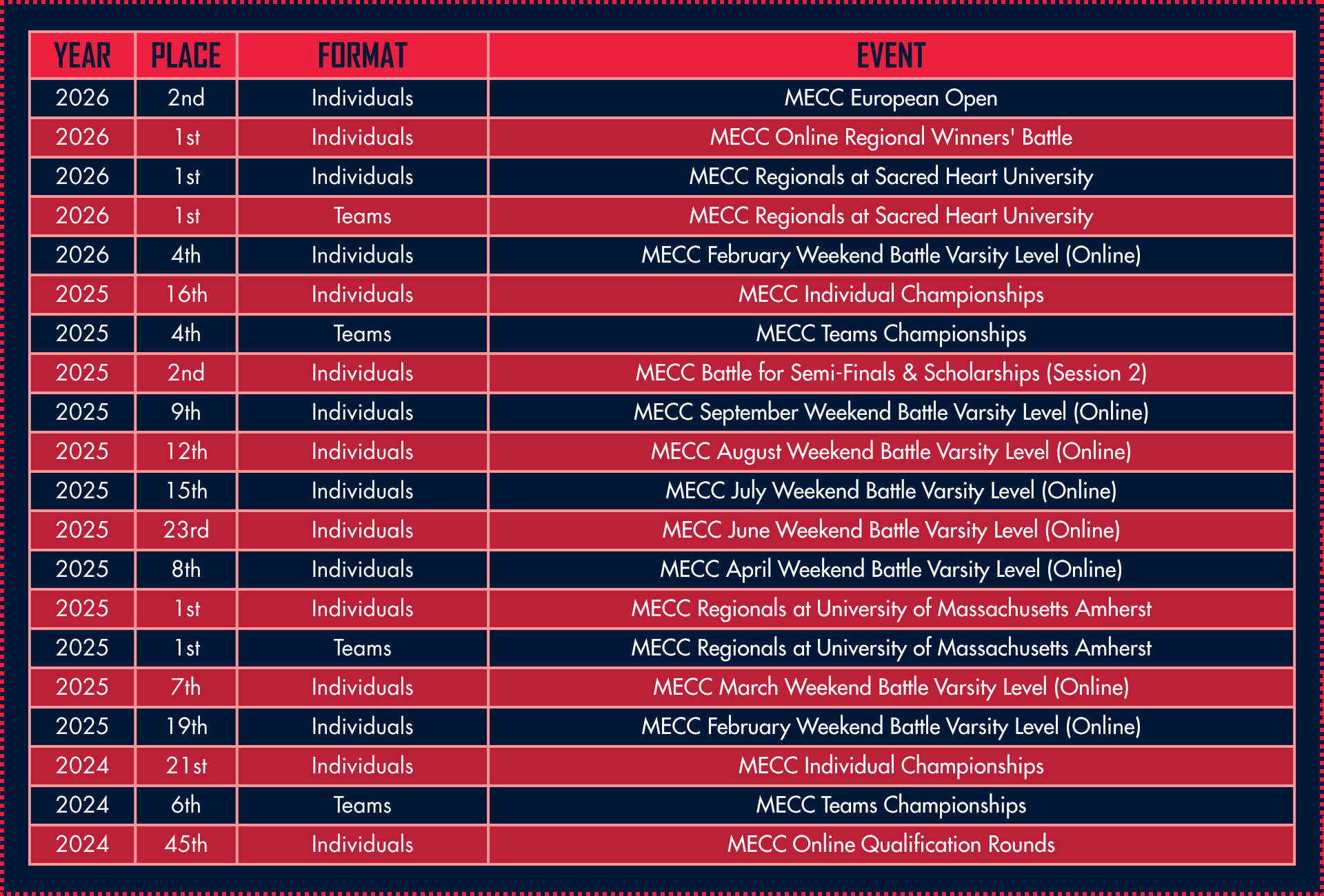
Luke first entered the world of Excel Esports through the 2024 MECC Online Qualification Rounds finishing 45th, before going on to compete at the 2024 MECC Teams Championships finishing 6th and the 2024 MECC Individual Championships finishing 21st in Las Vegas. Throughout his journey, Luke also competed in numerous online Weekend Battles, consistently putting his skills to the test between major events. As Team Captain of the Messiah University Excel Team, Luke led his group to victory at the 2025 MECC Regional Teams Competition at University of Massachusetts Amherst, qualifying them for the 2025 MECC Championship in Las Vegas, also claiming first place individually at the 2025 MECC Regionals at University of Massachusetts Amherst. At the 2025 MECC Individual Championships in Las Vegas, Luke finished 16th individually, and alongside his team finished 4th at the 2025 MECC Teams Championships. He then returned in 2026 to lead his team to another Regional victory at the MECC Regionals at Sacred Heart University, winning both the individual and team competitions. From there, Luke claimed first place individually in the 2026 MECC Online Regional Winners’ Battle, earning his spot in the Student Finals at the 2026 MECC European Open in Amsterdam. What made that moment even more special was how unexpected it felt. “I was in my college apartment and after it happened, I walked out to my roommates and I was like, guys, somehow, I won this.” And reflecting on the journey to Amsterdam, Luke admits the whole experience felt surreal. “Wow, I’m gonna be able to go to Amsterdam to compete in Excel competitions. I’m so grateful to the MECC team who empowered me to be here.” Competing on that international stage, Luke achieved a second-place finish and solidified his place among the top student talents in the field.
While individual glory is thrilling, Luke’s journey has always been shaped by collaboration. At the 2025 MECC Team Championships in Las Vegas, Luke and his teammates had to work in sync, trusting each other every step of the way. Having competed in both individual and team formats, Luke speaks passionately about the difference. “With teams you have the ability to check over each other’s work. If somebody drops the ball, you can carry over and pick up the plate for them.” For Luke, neither format wins outright. “I would love to keep doing both. They’re definitely entirely different animals.” Luke’s journey is proof that the best results come not just from personal excellence but from the trust and collaboration built between teammates.
Many people assume that winning an Excel competition is simply a matter of memorising formulas. But as Luke’s journey demonstrates, technical knowledge is only half the battle. Luke himself is proof of this. His approach is deliberate and methodical rather than reliant on advanced formulas. “I don’t often do really complex single cell formulas. For me, success often comes from spending a lot of time making a model that I understand and if there’s a problem I can go back and audit it.”
For universities seeking to enhance their students’ employability, participation in MECC offers significant advantages that extend beyond the competition. By engaging in these challenges, students develop highly transferable skills in data analysis, logical thinking, and business modeling while gaining valuable experience applying theoretical knowledge to complex real world scenarios. When asked what he would say to students and faculty considering MECC, Luke is clear: “MECC is development of a lot more than just Excel. What separates the best Excel champions from the people who don’t end up winning is the problem solving ability and not Excel knowledge. This is a problem solving, critical thinking competition even more than it is just developing Excel strengths.” MECC also enables meaningful connections between students, recruiters, and employers, allowing participants to demonstrate their resilience under pressure and access broader professional networks. These benefits contribute to both individual career advancement and the overall reputation of participating universities as leaders in innovative education.
Looking at Luke on international stages, we see the result of a steady learning curve built on persistence and a willingness to fail forward. Luke is refreshingly honest about his own beginnings. “The first competition that I did was abysmal. I was like, how are people fully solving this and I did like two levels.” But rather than walking away, Luke chose to stick with it. “You really just need to see that it is possible and you are capable of it. If it’s something that you want to achieve, just choose to commit to it. Choose to compete and do your best, that’s all you can do.” For any student hesitant to sign up, Luke’s journey from two levels completed to second place on an international stage is the most compelling answer there is.
To outsiders, Excel Esports sounds like a paradox. How do spreadsheets become a spectator sport? Luke has faced this question more than most. “When you tell people I do competitive Excel, they go either OK or they go that’s really cool, tell me more.” Organised by MECC, the competition transforms data analysis into a spectator-friendly sport. With many different game formats including live elimination style games, players have their screens broadcast to thousands of viewers online while commentators analyse their every keystroke. It is fast, high stakes, and as Luke would tell you, incredibly hard to put into words until you experience it yourself.
For Luke, the medals and trophies are only part of the reward. As his MECC chapter closes, it is the people and connections he keeps coming back to. “There are some great people here. I’ve made some great connections and friendships here.” And while Luke is unsure of exactly what comes next in the world of Excel Esports, one thing is certain. “I don’t think I’ll just let it go forever.” Above all, before taking to the stage for the 2026 MECC European Open Finals, Luke’s words captured a value MECC stands for “I couldn’t do it without my family and my Messiah University faculty and friends. I am just in an environment like this filled with gratitude and even if I don’t do great today, I’m still so grateful of just being here and the people who have poured so much into me.” That gratitude, growth, and the community is exactly what MECC is built on.
Want to hear more about the strategy, the high-pressure moments, and the behind-the-scenes reality of competitive Excel esports? Watch our full video interview with Luke Peyton:
© 2022-2026 Microsoft Excel Collegiate Challenge. All rights reserved.